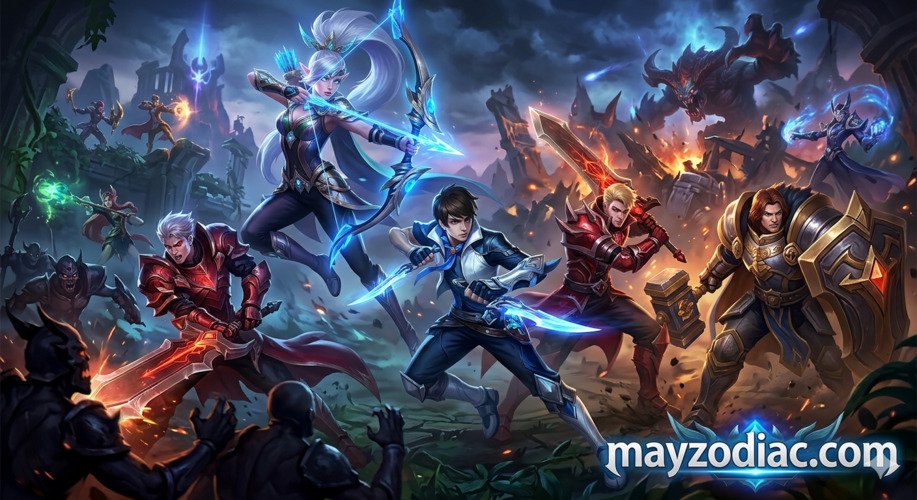
mayzodiac.com – In a game as fast-paced as Mobile Legends: Bang Bang, it is easy to become trapped in the present. Every second feels urgent. Every movement seems to demand immediate response. Every decision appears to carry instant consequence. Players are constantly pulled into the now—into the visible, the immediate, the pressing.
Yet beneath this intensity lies a quieter truth: the game is not decided by isolated moments, but by the continuity that connects them.
Long-term thinking is the ability to see beyond what is happening now. It is the discipline of understanding that every action is part of a larger sequence. It is not about ignoring the present, but about placing the present within a broader context.
Players who develop this mindset begin to experience the game differently. They are less reactive, less rushed, and less affected by short-term fluctuations. Instead, they operate with a sense of direction—a quiet awareness that what they are doing now is shaping what will happen later.
This perspective does not slow them down. It gives their actions meaning.
The Early Game: Planting Decisions That Will Grow Later
At the start of a match, the early game often feels like a preparation phase—a time to gather resources, adjust positioning, and settle into rhythm. Many players treat it as something temporary, disconnected from what comes next.
But long-term thinkers see it differently. They understand that the early game is not separate from the late game. It is the foundation upon which everything else will be built.
Every small decision—where to stand, how to move, when to act—creates subtle shifts that accumulate over time. These shifts may not be visible immediately, but they shape the future state of the game.
This awareness changes behavior. Players begin to treat early moments with care, knowing that they are not just reacting—they are building.
Choosing Stability Over Immediate Gain
The early game often presents opportunities for quick advantage. A small opening appears, and the instinct is to take it immediately. While some of these opportunities are valid, many come with hidden costs.
Long-term thinking introduces patience. Instead of chasing every short-term gain, players evaluate whether an action strengthens or weakens their future position.
Sometimes the better choice is not the one that gives the fastest result, but the one that preserves stability.
This approach may seem slower, but it creates consistency. It ensures that progress is not undone by unnecessary risk.
Building Patterns That Carry Forward
Early decisions are not isolated—they form patterns. These patterns influence how players move, how they respond, and how they adapt throughout the match.
By focusing on clarity and consistency early, players establish patterns that support them later. They create a rhythm of decision-making that remains stable even as the game becomes more complex.
These patterns become a form of memory. When pressure increases, players fall back on what they have already practiced.
In this way, the early game quietly prepares the mind for what is to come.
The Mid-Game: Connecting Actions Into a Coherent Direction
As the game transitions into the mid-phase, the pace increases and the environment becomes more dynamic. Decisions are no longer isolated—they begin to connect.
Long-term thinking becomes more visible here. Players start to see not just individual actions, but sequences. They understand how one decision leads to another, how positioning influences future movement, and how timing shapes upcoming opportunities.
This perspective creates coherence. Actions are no longer random—they are part of a larger flow.
Players begin to move with intention, aligning each decision with the direction they want to create.
Managing Uncertainty Without Losing Direction
The mid-game introduces uncertainty. Situations change quickly, and outcomes are not always predictable. For many players, this uncertainty creates hesitation or impulsive reactions.
Long-term thinkers respond differently. They accept uncertainty as part of the game, but they do not let it disrupt their direction.
They continue making decisions based on their understanding, adjusting when necessary but maintaining a sense of purpose.
This balance between flexibility and direction is key. It allows players to adapt without becoming lost.
Letting Go of Short-Term Frustration
Not every decision leads to immediate success. Even well-thought-out actions can produce unfavorable results due to factors beyond control.
Without long-term thinking, this can lead to frustration. Players may question their approach, abandon their strategy, or act impulsively in response.
Long-term thinkers avoid this trap. They understand that individual outcomes do not define the overall process.
By letting go of short-term frustration, they maintain stability. They continue building toward their goal, trusting that consistency will eventually create results.
This mindset protects focus and prevents emotional disruption.
Aligning With the Flow of the Game
The mid-game is where the flow of the match becomes more apparent. Momentum shifts, patterns emerge, and the overall direction begins to take shape.
Players who think long-term align themselves with this flow. They do not fight against it unnecessarily. Instead, they adjust their actions to fit the evolving state of the game.
This alignment creates efficiency. Actions feel natural, connected, and effective.
Rather than forcing outcomes, players guide them.
Recognizing That Every Decision Carries Weight
In the late game, the margin for error becomes small. Decisions carry greater consequences, and the outcome of the match often depends on a few critical moments.
Long-term thinking reaches its peak here. Players understand that every action is not just a response—it is a conclusion of everything that came before.
They act with awareness, recognizing the weight of their decisions without becoming overwhelmed by it.
This awareness creates precision. Actions are chosen carefully, aligned with both the present situation and the broader context of the match.
Avoiding the Urge to Rush the Ending
When victory feels close, impatience often appears. Players may try to finish the game quickly, acting with urgency rather than clarity. This is one of the most common late-game mistakes.
Long-term thinkers resist this urge. They understand that rushing can disrupt the stability they have built. Instead, they maintain their approach. They continue making deliberate decisions, ensuring that the final steps are as controlled as the ones that came before. This discipline protects progress.
Balancing Confidence With Caution
Late-game decisions require both confidence and caution. Too much caution leads to missed opportunities, while too much confidence leads to mistakes.
Long-term thinking creates balance. Players trust their judgment, but they also respect the uncertainty of the situation.
This balance allows them to act decisively without becoming reckless. It is a quiet form of control—one that does not rely on force, but on understanding.
Closing the Game as a Continuation, Not a Separate Moment
Many players treat the end of the match as something different—a final phase where everything changes.
But for long-term thinkers, the ending is simply a continuation. It is not separate from what came before—it is the result of it.
By maintaining their mindset, they ensure that the quality of their decisions remains consistent. Closing the game becomes a natural extension of their process, not a sudden shift. This continuity is what leads to reliable success.
Conclusion: Thinking Beyond the Immediate
Mobile Legends: Bang Bang is a game that constantly pulls players into the present. Its pace, its intensity, and its demands all encourage immediate reaction.
Yet true mastery lies in stepping beyond that pull.
Long-term thinking does not ignore the present—it gives it context. It connects actions across time, turning isolated moments into meaningful sequences.
From the early game’s quiet foundations to the mid-game’s evolving direction and the late game’s decisive execution, this mindset shapes every phase.
Players who embrace it become more stable, more consistent, and more resilient. They are less affected by short-term fluctuations and more focused on their overall path.
In the end, Mobile Legends becomes more than a series of fast decisions. It becomes a continuous process of thought—where those who see beyond the moment are the ones who act with purpose, adapt with clarity, and ultimately secure victory.