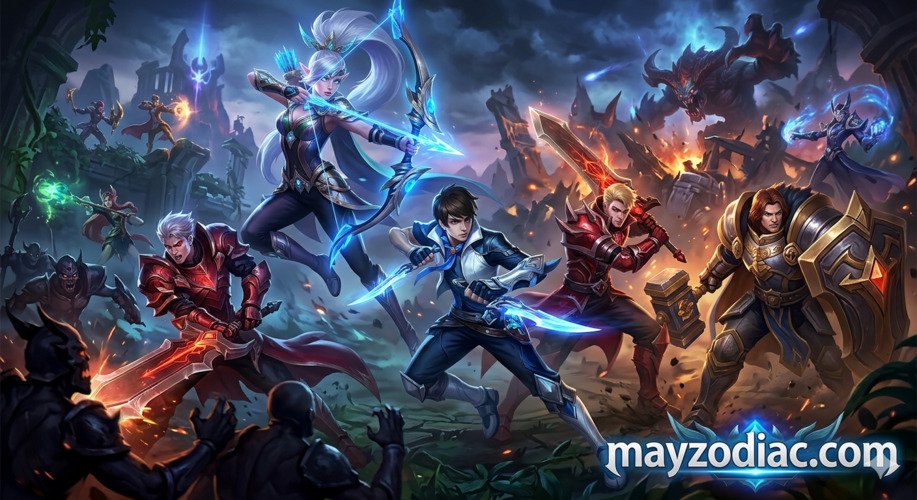
mayzodiac.com – The mobile gaming industry has expanded rapidly, and among the titles that have shaped its competitive scene, Mobile Legends: Bang Bang remains one of the most influential. It has become more than a simple smartphone game; it is a competitive ecosystem where millions of players engage daily in fast-paced matches that test strategy, mechanics, and teamwork. From casual players enjoying a quick match to professional athletes competing in international tournaments, Mobile Legends has created a broad community that continues to grow.
At first glance, the game seems easy to understand. Two teams of five players face each other on a map, each controlling a unique hero, with the objective of destroying the enemy base. The controls are designed for touchscreens, making it accessible even to players who are new to multiplayer online battle arena games. Yet the simplicity of its controls often hides the depth of its gameplay. Winning consistently requires much more than fast fingers. It demands awareness, patience, communication, and the ability to adapt to changing circumstances.
This complexity is what gives Mobile Legends its enduring appeal. Every match feels like a fresh challenge because each game unfolds differently. Hero combinations, player behavior, and split-second decisions all interact to create a unique competitive experience. Over time, players realize that improving is not only about playing more but also about understanding the systems that define the game.
Learning the Foundations of Mobile Legends
The map in Mobile Legends is divided into three main lanes. These lanes connect the two bases and are lined with towers that protect the path toward the final objective: the enemy crystal. To win, a team must destroy these towers and eventually reach the crystal.
Between the lanes lies the jungle, an area that plays a major role in resource management. Neutral monsters appear here and grant gold, experience, and buffs when defeated. Controlling the jungle can significantly accelerate a team’s growth, especially for heroes assigned as junglers.
Many beginners assume that the main goal is to secure as many kills as possible. While eliminations can create opportunities, the true objective is to control the map and destroy structures. A team that focuses solely on kills may still lose to a team that prioritizes towers and major objectives.
Understanding this distinction is essential. Mobile Legends rewards strategic thinking more than reckless aggression.
The Role of Heroes in Team Composition
A major feature of Mobile Legends is its large roster of heroes. Each hero belongs to a role: tank, fighter, assassin, mage, marksman, or support. These roles determine how a hero contributes to the team.
Tanks are the front-line protectors, designed to absorb damage and initiate battles. Fighters combine offense and defense, making them durable in close-range fights. Assassins specialize in eliminating fragile targets quickly. Mages provide magical burst damage and crowd control. Marksmen deal sustained ranged damage and often become strongest in the late game. Supports assist allies with healing, shielding, or utility.
A team’s success often depends on role balance. A lineup without a durable front line may struggle to protect its damage dealers. A lineup with insufficient damage may fail to capitalize on opportunities.
This makes hero selection an important strategic decision. Strong players choose heroes not only based on preference but also on what complements the team.
Match Phases and Strategic Progression
Every Mobile Legends match can be divided into early game, mid game, and late game. Each stage changes the priorities of the players.
The early game focuses on farming. Players collect gold and experience through minions and jungle camps while establishing lane control. This phase sets the foundation for later battles.
The mid game begins when players start rotating between lanes. Team fights become more frequent, and objectives such as the Turtle become central. This phase often determines which team gains momentum.
The late game is where every mistake becomes dangerous. Heroes are stronger, death timers are longer, and a single lost team fight can end the match. The Lord becomes the most important objective, capable of helping teams break through defenses.
Understanding the timing of these phases allows players to make better strategic choices.
How to Improve and Play More Effectively
One of the most important aspects of Mobile Legends is farming. Farming means collecting gold and experience efficiently. This includes clearing minion waves, defeating jungle monsters, and securing neutral objectives.
Many new players overvalue kills. While kills are visually satisfying, farming often has a greater long-term impact. A player who farms consistently can build items faster and become stronger than an opponent with more kills but poor resource management.
The Gold lane provides extra gold, especially benefiting marksmen. The EXP lane accelerates leveling for heroes who rely on early skill upgrades. Understanding lane assignments helps maximize efficiency.
Strong farming requires patience. Players must know when to ignore risky fights and continue building their economic advantage.
Rotations and Map Awareness
Rotations are one of the key skills that separate advanced players from beginners. Rotating means moving between lanes to support teammates, secure objectives, or pressure enemy towers.
A player who clears a wave quickly can rotate to another lane and create a temporary numbers advantage. This can lead to successful ambushes or tower destruction.
Map awareness is essential for effective rotations. Players must constantly monitor the mini-map to track enemy positions. If several enemies disappear, overextending becomes dangerous. If enemies are visible elsewhere, opportunities may open for aggressive plays.
This awareness transforms the game into more than direct combat. It becomes a contest of information and prediction.
Team Fights and Positioning
Team fights are often the most decisive moments in Mobile Legends. These large-scale engagements usually happen around objectives such as Turtle, Lord, or important towers.
Winning team fights requires coordination. Tanks must initiate when the team is ready. Marksmen and mages must stay safe while dealing damage. Assassins must target priority enemies rather than attacking randomly.
Positioning is critical. A hero caught out of place can be eliminated instantly, leaving the team at a disadvantage. The best players understand where to stand and when to move during chaotic battles.
The strongest teams do not fight just for the sake of fighting. They fight to secure objectives that lead to victory.
Constant Updates and New Strategies
A major reason for the game’s long-term success is the regular updates from Moonton. These updates introduce new heroes, balance changes, and adjustments to items or mechanics.
This creates a shifting meta, where certain strategies become stronger or weaker over time. Players must adapt to remain competitive.
The changing meta keeps the game fresh and ensures that even experienced players continue learning.
Emotional Control in Competitive Matches
Mobile Legends is not just about technical skill. It also tests emotional resilience. Ranked matches can be stressful, especially when mistakes lead to defeat.
Players who become frustrated often make poor decisions. They may chase enemies recklessly or stop cooperating with teammates. Calm players are more likely to recover from setbacks and identify opportunities for comeback.
Learning emotional discipline is therefore a key part of becoming a better player.
Teamwork as the Core Experience
At its heart, Mobile Legends is a team game. Individual skill can influence a match, but teamwork often determines the final outcome.
A coordinated team can overcome stronger individual opponents through communication, positioning, and shared objectives. Even simple pings can create effective cooperation.
This shared effort creates the most memorable moments. A well-coordinated final push or a perfectly timed team fight often becomes the highlight of an entire match.
Conclusion Mobile Legends and the Art of Understanding Competitive Team Play
Mobile Legends: Bang Bang is much more than a casual mobile title. It is a complex competitive experience that combines mechanics, strategy, and teamwork into every match.
To play well, players must understand the map, hero roles, farming, rotations, and team fights. Beyond these mechanics, they must also develop adaptability, emotional control, and cooperation.
This combination of accessibility and depth is why Mobile Legends continues to attract millions of players worldwide. It is easy to begin but challenging to master, offering endless opportunities for improvement.
In the end, Mobile Legends is not simply about destroying the enemy crystal. It is about learning how to think strategically, adapt to changing situations, and work with a team to overcome challenges in a dynamic competitive environment.