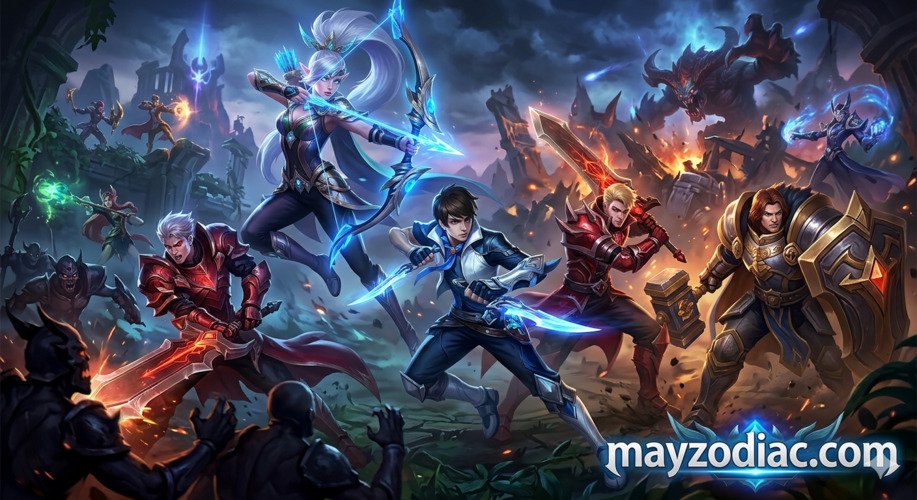
mayzodiac.com – In the fast-paced world of competitive mobile MOBAs, understanding heroes is the foundation of consistent victory. Every match in Mobile Legends: Bang Bang is shaped not just by mechanical skill, but by how well players interpret roles, timings, and synergy between heroes. While the game offers a wide roster of characters, success rarely depends on simply picking a “strong hero.” Instead, it is about knowing how each hero functions within a team, how they scale across the match, and how they interact with both allies and enemies.
This article breaks down hero mastery into three essential layers: understanding core roles, applying strategic gameplay across phases, and developing advanced competitive adaptation. Each layer builds on the previous one, forming a complete mindset for improving decision-making and gameplay consistency.
Understanding Core Hero Roles and Their Battlefield Identity
Every hero in Mobile Legends is designed with a specific battlefield identity. These identities are not just labels; they define how a player should think, move, and engage in fights. A team without role clarity often collapses under pressure, while a well-balanced composition can dominate even mechanically stronger opponents.
Tanks are the backbone of team composition. Their primary responsibility is to absorb damage, create space, and initiate fights at the right moment. Unlike damage dealers who rely on kills, tanks are evaluated by their ability to influence positioning and protect allies.
A strong tank player understands timing more than aggression. Engaging too early can waste cooldowns and lead to a failed fight, while engaging too late allows enemies to secure objectives uncontested. Heroes in this category often have crowd control abilities such as stuns, knock-ups, or slows, which allow them to disrupt enemy formations.
Initiators, often overlapping with tanks, carry the responsibility of starting team fights in favorable conditions. The difference lies in precision: an initiator does not simply absorb damage but actively forces engagement when vision and positioning are advantageous. Good initiators read enemy movement patterns, wait for cooldown windows, and strike when key enemy damage dealers are exposed.
Mastering this role requires patience. Many players underestimate how much impact a tank has simply by existing in the correct position, zoning enemies away from objectives, and protecting fragile teammates.
Marksmen and Damage Scaling: The Late-Game Win Condition
Marksmen are often considered the primary damage dealers in late-game scenarios. Their strength increases exponentially as they acquire core items, making them essential for closing out matches.
However, marksmen are also the most vulnerable heroes in early stages. Without proper protection and positioning, they can easily be shut down by assassins or aggressive fighters. This creates a unique duality: they must farm efficiently while avoiding unnecessary risks.
A skilled marksman player prioritizes consistency over aggression. Every minion wave, jungle rotation, and safe poke contributes to scaling faster than the enemy. Positioning becomes the most important skill—standing too far forward often results in instant elimination, while staying too far back reduces damage contribution.
In team fights, marksmen are not supposed to initiate or chase blindly. Instead, they function as sustained damage providers, targeting whoever is accessible while maintaining safe distance. Their success is often directly tied to how well their team protects them.
Mages and Burst Control: The Mid-Game Power Controllers
Mages typically dominate the mid-game phase, where their burst damage and crowd control abilities become crucial in skirmishes and objective fights. Unlike marksmen who rely on sustained damage, mages deliver impact in short, explosive bursts.
Many mage heroes also provide utility—such as zoning, slowing enemies, or controlling areas of the map with skill effects. This makes them extremely valuable during turret sieges and jungle fights.
The key to mastering mage heroes lies in skill accuracy and timing. Missing key abilities can completely reduce their effectiveness in fights. On the other hand, landing a well-timed combo can instantly shift the momentum of a battle.
Positioning is also critical for mages. They often operate from mid-range, balancing aggression and safety. A good mage player constantly evaluates enemy cooldowns and positioning before committing to a fight.
Strategic Gameplay and Hero Synergy in Different Phases
Winning in Mobile Legends is not only about individual hero strength but also about how heroes perform across different stages of the match. Each phase—early, mid, and late game—requires a different mindset and approach.
The early game is about foundation building. Heroes must focus on laning efficiency, wave control, and avoiding unnecessary deaths. During this phase, even small advantages can snowball into significant mid-game leads.
Each lane has a unique responsibility. Side laners often focus on sustaining and surviving, while mid laners prioritize rotation opportunities. Jungle heroes aim to secure buffs and create early pressure through ganks.
A critical aspect of early game success is map awareness. Players who consistently track enemy movements gain a strategic advantage, allowing them to avoid ganks and respond to threats before they develop.
Early aggression must be calculated. Overcommitting without vision or backup often leads to disadvantageous trades. Instead, controlled pressure—such as forcing enemy recalls or denying farm—is more effective for long-term success.
Mid Game Rotations and Objective Control
The mid game is where most matches are decided. Towers begin to fall, teams group more frequently, and objectives such as Turtle fights become highly contested.
During this phase, hero synergy becomes crucial. Teams must coordinate rotations to outnumber enemies in key areas of the map. A single well-timed rotation can secure objectives and open space for further map control.
Junglers and roamers play a vital role in setting the pace. They dictate when fights happen and where pressure is applied. Meanwhile, damage dealers must balance farming with participation in skirmishes.
Understanding power spikes is essential. Some heroes become significantly stronger after acquiring specific items or levels. Recognizing these spikes allows teams to force favorable fights or avoid disadvantageous engagements.
Mid game also introduces more complex decision-making. Teams must choose between pushing lanes, securing objectives, or forcing fights. Poor decision-making during this phase often leads to irreversible disadvantages.
Late Game Teamfight Execution and High-Stakes Decisions
The late game is where one mistake can determine the outcome of the entire match. At this stage, death timers are long, and objectives like Lord become decisive win conditions.
Team fights become highly structured. Positioning, vision control, and cooldown management are more important than raw damage. Heroes must execute their roles with precision.
Marksmen and mages usually become the primary damage sources, while tanks and supports focus on peeling and disruption. Assassins look for opportunities to eliminate key targets, but must be extremely careful due to high-risk engagements.
Objective control becomes the central focus. Securing Lord often leads directly to base pushes and game-ending scenarios. As a result, teams must balance aggression with patience, ensuring they do not overextend or engage in unfavorable fights.
Late game success depends heavily on discipline. Teams that maintain formation and avoid unnecessary risks tend to perform better than those relying on individual outplays.
Beyond basic role understanding and phase-based strategy, true mastery in Mobile Legends comes from adaptation. High-level players constantly adjust their builds, positioning, and decision-making based on enemy composition and game flow.
Itemization and Build Flexibility
Itemization is one of the most underrated aspects of hero mastery. Many players rely on fixed builds, but competitive gameplay demands flexibility.
For example, defensive items may be necessary even for damage-oriented heroes if the enemy team has strong burst potential. Similarly, penetration items become essential when facing tank-heavy compositions.
Understanding situational builds allows players to extend their survival while maintaining impact. It also forces opponents to adapt, often disrupting their original game plan.
Build flexibility is not about memorizing multiple item sets but about understanding why each item exists. Once a player understands the function behind items, decision-making becomes significantly more intuitive.
Positioning and Mechanical Execution Under Pressure
Mechanical skill is important, but positioning is what separates average players from consistent performers. Even highly skilled players can fail if they position poorly in critical moments.
Positioning involves constantly evaluating distance, enemy threat range, and escape options. It is not static; it changes every second based on enemy movement and cooldown availability.
Mechanical execution complements positioning. Landing abilities, chaining combos, and reacting quickly to threats are all part of high-level play. However, mechanics without positioning often lead to high-risk, low-reward scenarios.
Under pressure, players must remain calm and prioritize survival over flashy plays. The best players know when to disengage, reset, or re-enter fights based on evolving conditions.
Drafting, Counterpicks, and Team Composition Strategy
Drafting is the first battlefield where matches are won or lost. Choosing heroes without considering enemy composition often leads to structural disadvantages before the game even begins.
Counterpicking involves selecting heroes that directly challenge enemy strengths. For example, choosing heroes with strong crowd control against mobile assassins can neutralize their impact.
Team composition also matters significantly. A balanced team typically includes frontline durability, sustained damage, burst potential, and utility. Missing one of these components can make a team predictable and easier to counter.
High-level drafting also considers synergy. Certain heroes perform significantly better when paired with specific allies. Understanding these combinations allows teams to create powerful engagements and coordinated strategies.
Ultimately, drafting is a mental game. It requires prediction, adaptation, and deep understanding of both your own team and the enemy’s win conditions.
Conclusion Mastering Heroes in Mobile Legends: Roles, Strategy, and Advanced Gameplay Insights
Mastering heroes in Mobile Legends is not just about mechanical skill or knowing individual abilities. It is about developing a layered understanding of roles, timing, and adaptation across every phase of the game. From the foundational responsibilities of tanks, marksmen, and mages, to the strategic execution of early, mid, and late game phases, and finally to the advanced decision-making involved in itemization and drafting, every layer contributes to overall performance.
Players who consistently improve are those who think beyond individual fights and instead view the game as a dynamic system of interactions. Every hero has a purpose, every phase has a strategy, and every decision carries weight.
By internalizing these principles, players can transition from simply playing heroes to truly mastering them, turning each match into an opportunity for controlled, strategic dominance.