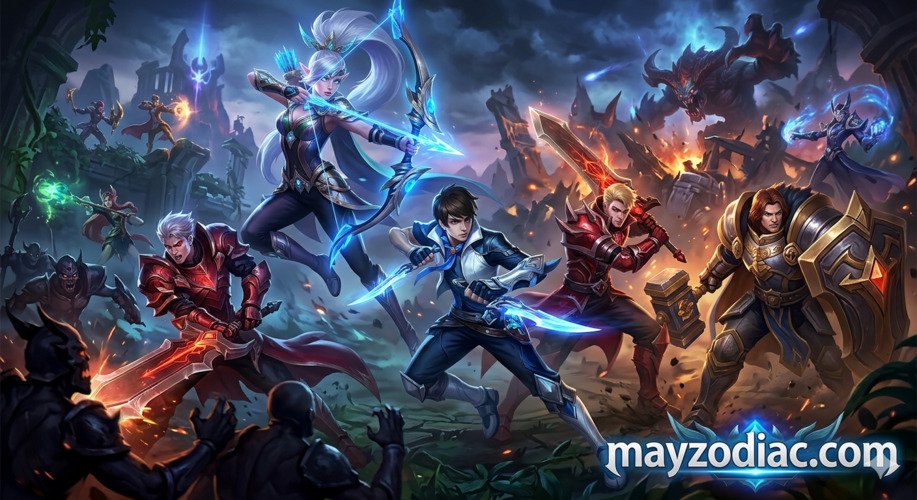
mayzodiac.com – Mobile Legends: Bang Bang is a multiplayer online battle arena game where success depends on much more than simply defeating enemy heroes. A player must understand the battlefield, manage resources, choose appropriate moments to fight, protect important objectives, and cooperate with teammates throughout the match. Every game develops differently because the heroes selected by both teams, the skill level of the players, the pace of the lanes, and the decisions made during crucial moments can completely change the outcome. For new players, the amount of information available on the battlefield can initially feel overwhelming. There are lanes to manage, jungle areas to monitor, turrets to defend, objectives to contest, and enemy movements that must constantly be considered. However, the basic concept becomes much easier to understand once the player recognizes how each part of the match connects to the others. Instead of treating every encounter as an opportunity to fight, a stronger approach is to think about what each action accomplishes for the team. Farming can create an item advantage, pushing a lane can force an enemy to respond, securing an objective can create map pressure, and simply showing or hiding in a particular area can influence the decisions of opponents. This means that becoming better at Mobile Legends is largely a process of improving decision-making. Mechanical skill remains important, especially when controlling heroes with demanding abilities, but good mechanics become considerably more valuable when they are supported by strong positioning and awareness. A player who understands when to attack, when to retreat, when to rotate, and when to ignore a fight can often contribute more consistently than someone who focuses exclusively on getting eliminations. The following guide explores the fundamentals of playing Mobile Legends effectively, from understanding roles and managing lanes to developing better macro awareness and coordinating team actions during the later stages of a match.
Understanding the Basic Flow of a Mobile Legends Match
One of the first steps toward becoming comfortable in Mobile Legends is understanding what your chosen role is expected to accomplish. Different roles contribute to a match in different ways, and playing well does not always mean having the highest number of eliminations. A tank or support may create opportunities for teammates by controlling vision, initiating fights, protecting vulnerable allies, or disrupting enemy formations. A marksman generally needs time and resources to become a reliable source of sustained damage, which means positioning and farming are especially important. A mage can provide burst damage, crowd control, area pressure, or zoning depending on the hero, while a fighter may combine durability with offensive pressure and often operate effectively in extended engagements. The jungler has a particularly influential position because jungle resources and early rotations allow this player to affect multiple areas of the map. Understanding these responsibilities changes the way a player interprets the match. For example, a marksman should not automatically chase an enemy into an unsafe area simply because an opponent has low health. Protecting farming tempo and maintaining a safe position may provide more value than attempting an uncertain elimination. Similarly, a tank should not judge performance solely by personal damage because creating space for teammates can be far more important. New players often improve quickly when they stop asking, “How can I get more kills?” and start asking, “What does my team need from my role right now?” This shift encourages better decisions and reduces unnecessary fights. It also makes team compositions easier to understand because every hero is contributing toward a broader strategy rather than operating independently. When players recognize their responsibilities, the match becomes less chaotic, and individual decisions begin to support the overall structure of the team.
Managing Lanes, Minions, and Gold Efficiently
Laning is another fundamental part of Mobile Legends because minions provide valuable resources while also creating pressure against enemy structures. A player who consistently collects minion waves can build items more quickly, reach important power spikes, and maintain a stronger presence throughout the game. However, simply clearing every wave as fast as possible is not always the ideal decision. The location of the minion wave matters because pushing too aggressively can expose a player to enemy rotations, while allowing an opponent to push freely can create pressure against a turret. Players should therefore develop an awareness of where the enemy heroes are before deciding how aggressively to manage a lane. If the opposing jungler has disappeared from the visible part of the map, pushing deep into enemy territory becomes more dangerous because the missing information creates uncertainty. On the other hand, if several enemy heroes are visible on the opposite side of the map, a player may have more freedom to clear a wave or pressure a turret. Last-hitting is also useful for maintaining reliable gold income, although players should avoid becoming so focused on individual minions that they ignore a developing team situation nearby. Good lane management involves balancing resources with safety and map awareness. Players should also understand that leaving a lane at the wrong time can cause an entire wave to be lost, reducing the economic advantage they could have gained. Rotations should therefore have a purpose. Moving toward another lane may be worthwhile if there is a realistic opportunity to secure an objective, help an ally, or pressure an enemy who is out of position. The strongest laners are not simply those who clear waves quickly; they are players who understand when to stay, when to rotate, and how to make their lane position create opportunities for the rest of the team.
Building a Strong Early-Game Routine
The early game establishes much of the rhythm that a Mobile Legends match follows. Players are gathering resources, completing their first items, testing the opposing team’s positioning, and establishing control over important areas of the map. A strong early routine begins with understanding the immediate objective rather than moving randomly between locations. A jungler needs an efficient route that provides resources while remaining aware of possible enemy interference. Laners should concentrate on securing their early economy without exposing themselves unnecessarily. Roaming players can look for opportunities to provide pressure, but they also need to avoid wasting too much time walking around without accomplishing anything. Every rotation should ideally have a reason. It might be intended to protect an ally, establish information, threaten an enemy, assist with an objective, or create pressure that forces an opponent to change position. The early game is also an excellent time to observe the enemy’s habits. A player may notice that an opposing laner repeatedly pushes forward, that an enemy jungler prefers a particular route, or that a certain hero becomes vulnerable after using an important ability. These observations can influence later decisions. Strong players do not treat each minute of the match as an isolated event. They collect information and use it to anticipate what could happen next. Even when a team does not secure an early advantage, disciplined play can prevent the opposing side from building an uncontrollable lead. Avoiding unnecessary deaths is especially valuable because dying removes a player’s presence from the map and can provide opponents with time to collect resources or attack structures. A calm early-game routine therefore creates a foundation for stronger mid-game decisions.
Developing Better Macro Gameplay and Team Coordination
Macro gameplay refers to the larger strategic decisions that determine where players move, what objectives they prioritize, and how they create pressure across the battlefield. One of the simplest ways to improve macro awareness is to develop the habit of checking the minimap regularly. The minimap provides information about enemy positions, allied movements, available objectives, and dangerous areas. A player who constantly watches only their own hero may react too late to important developments. In contrast, someone who regularly checks the map can recognize patterns before they become obvious. If multiple enemies disappear from their lanes simultaneously, that absence is itself information. It may indicate a rotation, an attempted ambush, or preparation around an objective. Players should not assume that missing enemies are harmless simply because they cannot currently be seen. Rotations should also be based on timing. Moving across the map requires time, and that time has an opportunity cost. If a player leaves a lane for an unsuccessful gank and misses several minion waves, the rotation may actually create a disadvantage even if the movement looked active. This is why efficient macro play is often less dramatic than constant fighting. Good decisions can involve staying in lane, waiting for an enemy to overextend, clearing a dangerous wave, or preparing an objective before the opposing team arrives. Another important concept is matching pressure. If an enemy player appears on one side of the map, teammates can consider whether there is an opportunity to take something valuable elsewhere. This does not mean blindly attacking another objective every time an opponent appears. The correct response depends on resources, hero positions, health, and the amount of information available. Macro gameplay improves when players begin evaluating the entire map rather than thinking only about the enemy directly in front of them.
Making Better Decisions Around Objectives
Objectives are among the most important elements of a Mobile Legends match because they can provide strategic advantages that extend beyond a single elimination. Major objectives often create moments when both teams are naturally drawn toward the same area, making preparation extremely important. Arriving early allows players to establish positioning, clear nearby waves, check potential approach routes, and create pressure before the objective becomes contested. Starting an objective immediately is not always the correct choice. Sometimes the better decision is to force the enemy away, wait for a key ability to become available, or remove nearby vision and information before committing resources. Teams should also consider whether their lanes are prepared. If an objective is being attacked while multiple allied minion waves are moving toward friendly structures, the team may be forced to abandon its advantage later because its base or turret becomes vulnerable. Objective control is therefore connected to lane management. A coordinated team thinks about the entire sequence rather than a single action. For example, clearing a side lane before moving toward an objective can force an opponent to choose between defending the lane and joining the contest. This creates pressure without requiring an immediate teamfight. Players should also recognize the difference between contesting and sacrificing an objective. If the opposing team has a major positional advantage, entering the area without preparation can result in multiple deaths and an even larger disadvantage. In some situations, collecting resources elsewhere, defending structures, or preparing for the next opportunity can be more sensible than forcing an unfavorable contest. These decisions require judgment because the value of an objective depends on the current state of the match. The important principle is to avoid treating every objective as an automatic command to fight. Instead, players should evaluate positioning, health, cooldowns, wave conditions, and available information before committing.
Improving Teamfights Through Positioning and Patience
Teamfights are often the most visually dramatic moments in Mobile Legends, but they can also be among the easiest situations in which to make a costly mistake. Successful teamfighting starts before abilities are even used. Players need to understand their own hero’s role, identify important enemy threats, and maintain a position that allows them to contribute without becoming an easy target. A marksman, for example, usually benefits from staying behind durable teammates and attacking targets that can be reached safely rather than diving toward the enemy backline without protection. A mage may need to preserve an important crowd-control ability for the moment when multiple opponents become vulnerable. A tank or initiator has different priorities, often looking for a favorable opening while considering whether teammates are close enough to follow. Patience is particularly important because using every ability immediately can leave a hero vulnerable when the real engagement begins. Players should pay attention to major enemy cooldowns and recognize when an opponent has already used a key escape or defensive tool. A fight can change dramatically after one important ability is wasted. Positioning also matters after the first exchange. Players should not assume that the fight is automatically won or lost because the opening sequence went well or badly. Some battles continue through several stages, with heroes repositioning, waiting for cooldowns, and changing targets. Target selection should reflect the current situation rather than a fixed priority list. A low-health enemy may be tempting, but chasing that target could expose the player to another opponent or pull the team away from a more important objective. Likewise, attacking a highly durable target for too long may allow the enemy’s damage dealers to operate freely. Good teamfights come from adapting to changing circumstances. The goal is not simply to press abilities quickly but to create favorable exchanges while protecting the heroes and resources that the team needs to continue controlling the map.
Conclusion How to Play Mobile Legends: A Complete Guide to Better Gameplay, Strategy, and Team Coordination
Improving at Mobile Legends is a gradual process that involves mechanical practice, strategic understanding, and increasingly accurate decision-making. Players who want to become more consistent should look beyond the number of eliminations shown on the scoreboard and examine how effectively they use resources, manage lanes, rotate around the map, protect objectives, and cooperate with teammates. Learning a role properly provides a foundation because it clarifies what the hero should accomplish at different stages of the match. From there, map awareness becomes one of the most valuable skills to develop. Checking enemy positions, understanding missing information, and recognizing when an opponent has rotated can prevent unnecessary deaths and create opportunities for the team. Objective control then becomes a natural extension of that awareness because strong objective play requires preparation rather than simply arriving at the location when the objective is available. Teamfights also become easier to manage when players understand positioning, timing, cooldowns, and target selection. Perhaps the most important lesson is that every match provides information that can be used to improve. A lost game can reveal poor positioning, inefficient rotations, weak lane management, or a tendency to fight without sufficient information. A winning game can still contain mistakes that should be corrected before the next match. By treating Mobile Legends as a combination of mechanics, resource management, communication, and strategic decision-making, players can gradually develop a more complete understanding of how the game works. The strongest improvement often comes not from playing faster, but from seeing more of the battlefield, understanding why a decision matters, and choosing actions that support the team’s next objective rather than focusing only on the immediate encounter.